
Why Women Are Investing in AI Skills in 2026 (And What It Means for the Future of Work)

In 2026, Women Aren’t Opting Out of Ambition — They’re Opting Into AI.
If you’ve ever been the person doing the invisible work — adapting faster than your role required, mentoring others without credit, holding teams together while waiting for recognition — this moment probably feels familiar.
Across industries, headlines are debating whether women are becoming “less ambitious.”
But beneath the noise, a quieter and far more strategic shift is underway. Women aren’t pulling back from growth.
They’re reallocating ambition toward something more durable than a title, a promotion, or a manager’s approval. They’re investing in themselves. And more specifically, AI literacy. Not because it’s trendy. Because it’s leverage.
In 2026, AI fluency is becoming one of the most portable, defensible forms of career power a woman can own — value that no company can take away, reschedule, or lay off.
The Headlines Say Women Are Less Ambitious. The Data Says Otherwise.
The latest Lean In × McKinsey Women in the Workplace 2025 report ignited debate with a provacative phrase: “the ambition gap.” For the first time in the study’s history, only 80% of women say they want to be promoted to the next level, compared with 86% of men — with the gap widest at entry and senior levels.
At first glance, it looks like women are leaning out.
But dig deeper, and a different story emerges.
When women receive the same sponsorship, stretch assignments, and career support as men, the ambition gap disappears. The issue isn’t drive. It’s a clear indication that the systems aren’t built for women to thrive.
Women aren’t less ambitious — they’re less interested in staying behind the scenes, doing invisible work, and hoping to one day get noticed.
Ambition Is Shifting: From Title to Tools, From Ladder To Leverage
Senior women’s ambition now centers on financial independence, decision-making power, control over time, and flexibility — with job title ranking fifth.
That shift isn’t accidental. Women are now prioritizing tools over ladders — capabilities that compound over time and travel across employers, industries, and chapters of life.
AI literacy sits at the center of that shift.
When women build AI foundations, they gain the ability to:
- Negotiate from strength
- Pivot roles or industries without starting over
- Lead AI-powered initiatives instead of being subject to them
- Build portfolios that signal future-ready value
- Multiply their energy rather than deplete it
This isn’t a softer ambition.
It’s a smarter one.
In 2026, women are investing in AI skills not to become engineers—but to stay relevant, confident, and in control of their careers. This shift reflects a deeper change in how women approach the future of work: strategically, collectively, and on their own terms.
The AI gap: Why Women Can’t Afford To Sit This One Out
While AI adoption accelerates, the gender gap is widening at exactly the wrong moment.
- Women are 22% less likely than men to use generative AI tools
- They hold roughly 20% of AI and data science roles
- They represent only 31% of AI course enrollments
Zooming in further, we know that women account for only:
- 22–29% of the AI workforce
- 14% of senior AI leadership
- 10% of top technology leadership
- 12–18% of advanced AI research roles
These aren’t abstract numbers. They are early warning signs.
If women aren’t fluent in AI — designing, questioning, and governing these systems — they risk being automated around rather than elevated through the next wave of work.
And that wave is coming fast.
More than 80% of business leaders expect AI agents to be embedded into daily operations within the next 12–18 months, reshaping productivity, management, and decision-making across every sector.
The Breakthrough Insight: When AI Learning Is Built for Women, Everything Changes
This is where the story turns hopeful — and concrete.
As Empressa began analyzing data for its Women in AI Quarterly Index, one insight appeared so consistently that it became the backbone of the entire report:
When women are placed in the right learning environment, they don’t merely adopt AI — they accelerate it, elevate it, and redefine what responsible AI leadership looks like.
That insight wasn’t theoretical.
It was observed — live, in real time.
In November 2025, Empressa’s AI Foundations for Women brought together 166 women across 33 live cohorts in a virtual, no-code AI learning lab. What unfolded over three hours challenged nearly every assumption about how AI skills are developed, and who thrives when given the chance.
The results:
- 90% attendance
- 98% completion
- 97% engagement
These outcomes far exceed typical technology training benchmarks — in some cases tripling them.
But the most important finding wasn’t the numbers themselves.
It was why they happened.
What The Index Revealed About How Women Actually Learn AI
Across cohorts, geographies, and experience levels, three patterns emerged consistently.
- Self-paced learning is failing women
Completion rates for solo, on-demand AI programs hover between 31–35%. Cohort-based models deliver 75–90% completion.
When women are left to learn alone, momentum stalls. When they learn together, confidence compounds. - Environment matters more than content
More than 82% of participants cited psychological safety as essential to engagement.
Peer encouragement, shared experimentation, and real-world examples unlocked confidence faster than any tutorial ever could. - Community transforms behavior — not just knowledge
Nearly 79% preferred hands-on, applied learning, and 83% showed higher retention in community-driven settings. Inside these spaces, women didn’t just absorb information. They tested. Questioned. Contributed.
And then came the surprise.
Across multiple sessions, we watched women move from hesitation… to experimentation… to contribution — within a single cohort experience. Not over months. Not after “getting more technical.” But through shared momentum and visible progress.
Why Access Isn’t Enough — And Architecture Changes Everything
These findings led to a clear conclusion:
Access to AI tools is not the problem.
The architecture of learning is.
When AI education is merely “open to women,” results remain uneven. But when it is intentionally designed around how women build confidence, capability, and leadership — adoption accelerates, and leadership behaviors emerge organically.
That insight became the heartbeat of the Women in AI Quarterly Index.
It also became the foundation for a new model — one that organizations, leaders, and learning institutions can use to accelerate equitable AI adoption at scale.
Because when women are placed in the right environment, they don’t just catch up to the future of work.
They help define it.
January is The Decision Point
January isn’t just the start of a new year. It’s when women decide whether they’ll be shaped by AI – or help shape it.
In January, Empressa is running AI Foundations for Women again — across multiple global time zones, with a bold but necessary mission: to help 2,500 women build AI literacy in 2026.
Because research alone doesn’t change outcomes.
Participation does.
These cohorts are designed to turn insight into momentum — bringing women together in live, facilitated sessions where AI becomes practical, human, and immediately usable.
What It Means to “Gift Yourself AI Literacy” in 2026
For many women, this decision is deeply personal.
It means:
- Choosing agency over waiting
- Promoting yourself into the future of work — without asking permission
- Becoming your own sponsor: buying the seat, blocking the calendar, and showing up with curiosity instead of credentials
In practice, that gift often looks like:
- A live, women-centered AI foundations cohort
- No-code, applied AI learning designed for non-technical professionals
- A certificate and portfolio that strengthen visibility and negotiating power
- A community where confidence is built collectively — and sustained
This is ambition, redefined.
Not smaller. Not quieter.
More intentional. More strategic.
And for those who want to expand the impact beyond themselves, there are multiple ways to get involved: by asking an employer to sponsor a seat or a cohort, by supporting the scholarship fund that widens access, or by claiming a place in the room directly.
Because when women invest in AI literacy — individually and collectively — they aren’t just preparing for the future of work.
They’re helping decide who gets to shape it.
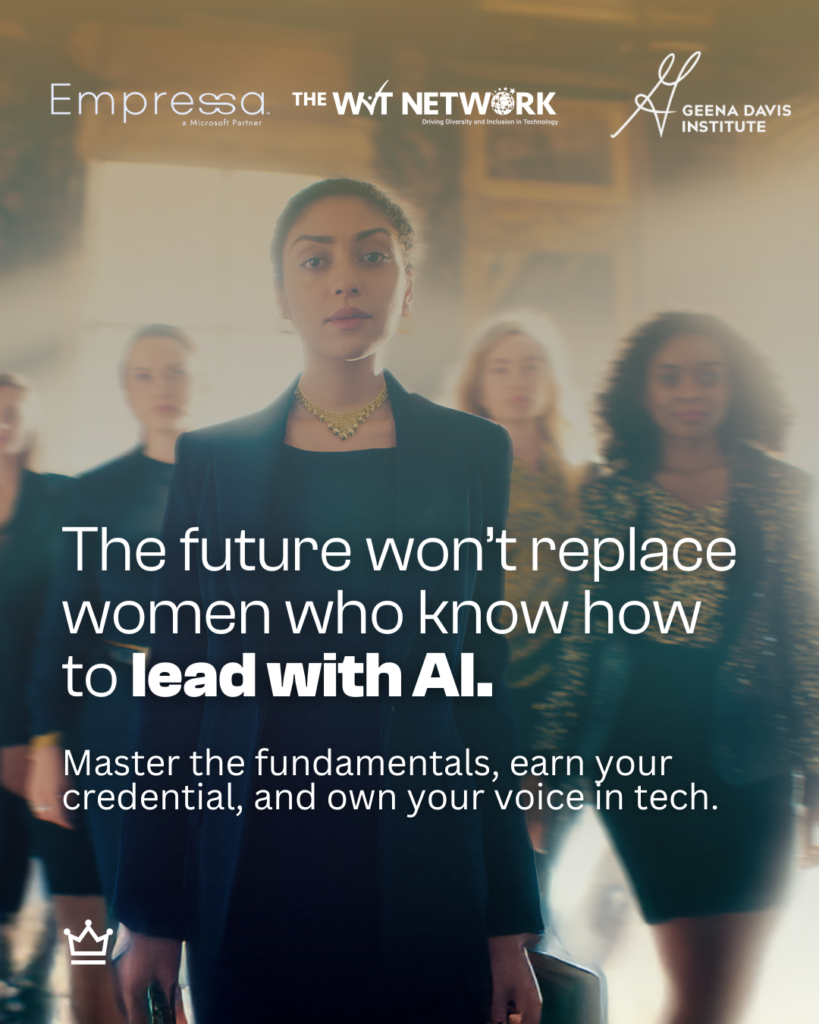
A Personal Invitation
If headlines made you question your ambition, let this be your reminder:
Wanting more control, more freedom, and more options is ambition.
In 2026, consider gifting yourself — and another woman — something that lasts:
- A seat in AI Foundations for Women
- Three focused hours that can change how you work
- A community that reminds you you’re not late — you’re right on time
Because when women invest in AI literacy, they don’t just learn a tool.
They claim their place in the rooms where the future is being designed.
And that may be the most powerful gift an Empress can open. 👑