
Women in AI Quarterly Index: Leading in the Portfolio Economy
Welcome to the Portfolio Economy
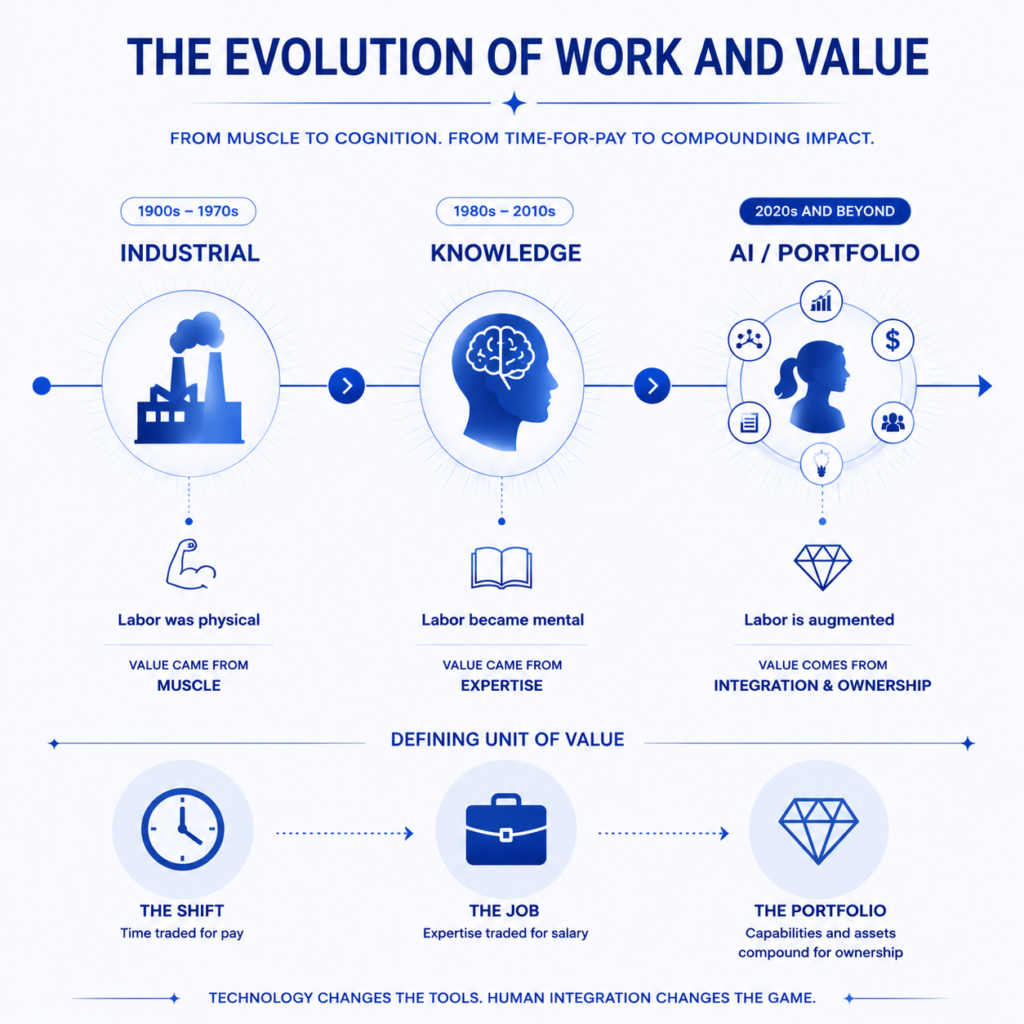
We are entering the portfolio economy—one where a woman’s career is no longer defined by a single employer, role, or ladder, but by a portfolio of skills, income streams, and identities she actively designs. In this new era, AI is not just another tool at work; it is the infrastructure that decides which skills are rewarded, whose labour is visible, and how fast careers can compound.
For senior women leaders, that shift is existential. The same algorithms that can accelerate your influence and income can also harden outdated assumptions about who is “ready,” “technical,” or “leadership material” if they are trained on yesterday’s rules. The portfolio economy puts women closer than ever to the economic upside of AI—and also closer to the risks of being automated, sidelined, or systematically underestimated.
Inside This Quarter’s Index
In the 2026 Q2 edition of the Women in AI Quarterly Index, we track how the rise of the portfolio economy is reshaping power, pay, and pathways for women in AI-critical roles. We look at where women are gaining leverage—through independent consulting, fractional leadership, portfolio careers, and IP ownership—and where institutional systems still assume a linear, “one job, one ladder” model that was never built for them.
You’ll find signal-rich data on who is actually using AI to design portfolio careers, how organizations are (or aren’t) recognizing that value, and what changes when women move from being “talent” inside the system to architects of it. Drawing on Empressa’s attribution-aware AI trained on verified insights from women leaders, the report goes beyond abstract statistics to surface grounded, practical patterns you can act on.
Why This Matters Now
AI adoption has passed the experimentation phase: governments, global enterprises, and high-growth companies are operationalizing AI across workflows, customer journeys, and capital allocation. At the same time, women remain underrepresented in the rooms where these systems are designed and overrepresented in roles most exposed to automation and algorithmic judgment. That combination is a risk factor—for women’s careers, for organizational resilience, and for the credibility of AI itself.
For senior women executives, the portfolio economy is an inflection point: you are no longer only responsible for your own trajectory; you are helping to define which forms of women’s work, expertise, and leadership are legible to AI in the first place. The decisions you make now—about governance, promotion criteria, vendor selection, reskilling, and incentives—will either compound the gender gap in AI or turn AI into an engine for closing it.
This report is designed as a boardroom tool: a way to move conversations about “bias in AI” beyond compliance and into strategy, value creation, and risk. If you are responsible for growth, transformation, or people, the Index offers a concrete way to see how your organization is treating women’s labour in an AI-first economy—and what you can redesign before those choices become encoded as default.
A New Mandate for Women Leaders
Empressa was built on a simple but radical premise: AI should not extract women’s insights; it should pay them for it. Our attribution-aware AI is trained exclusively on verified wisdom from women leaders, with royalties flowing back to the women whose expertise powers each response. In a portfolio economy, that model is more than fair—it is a blueprint for how institutions can recognize and reward the real value women create.
The Women in AI Quarterly Index takes that philosophy and turns it into an operating lens for senior executives. It offers practical prompts for boards and leadership teams: where to put women in the AI decision stack, how to update definitions of “merit” and “potential” before you automate them, and how to design AI programs that amplify women’s careers instead of quietly capping them.
If you are a senior woman leader—or an executive serious about equity, innovation, and long-term competitiveness—this quarter’s Index is your strategic briefing for the AI era.
Read the full Women in AI Quarterly Index Report – June 2026