
Women in AI Quarterly Index: The Value Capture Gap
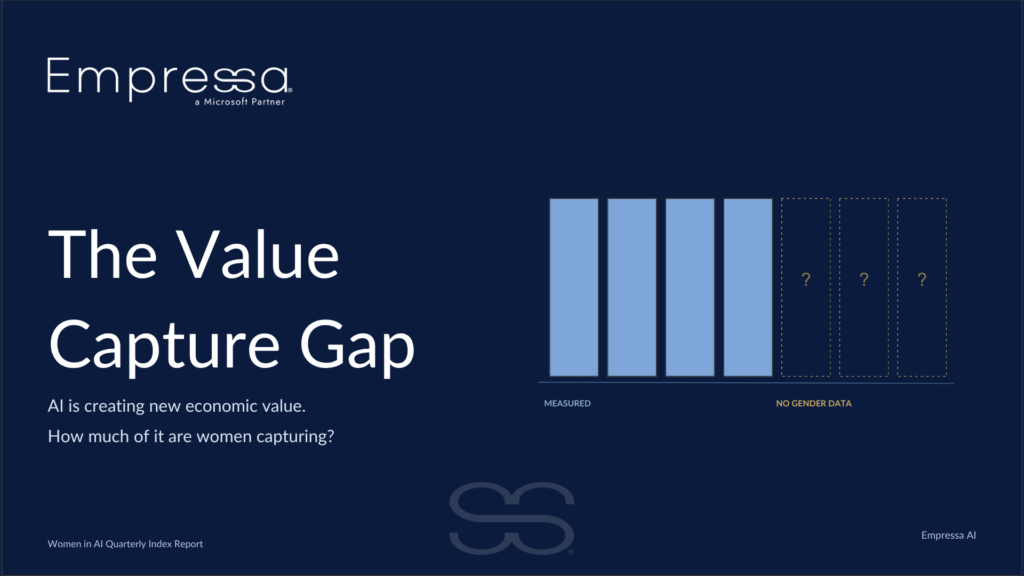
AI is creating new economic value. How much of it are women capturing?
In Q2’s Women in AI Index, we argued that AI is changing the economic structure of work. As execution gets cheaper, value moves toward judgment, orchestration, trust, and ownership. We called it the Portfolio Economy, and we said it could open an unusual advantage for women.
This quarter, we wanted to test that argument with numbers instead of conviction. So we asked one question: AI is creating new economic value, so how much of it are women actually capturing?
The answer surprised us. It’s also different from the story most people are still telling.
The familiar claim is that women face an AI access gap. They use AI less, and closing that gap is the work. As of Q3 2026, that story is half right and getting out of date. On the consumer side, the gap has closed. Inside the workplace, it persists, but the evidence points to how AI is handed out at work rather than what women choose. And more importantly, access is no longer the thing holding women back the most.
Inside This Quarter’s Index
In the 2026 Q3 edition of the Women in AI Quarterly Index, we track eight indicators across what we call the AI Value Chain. Seven have data. The eighth is the finding.
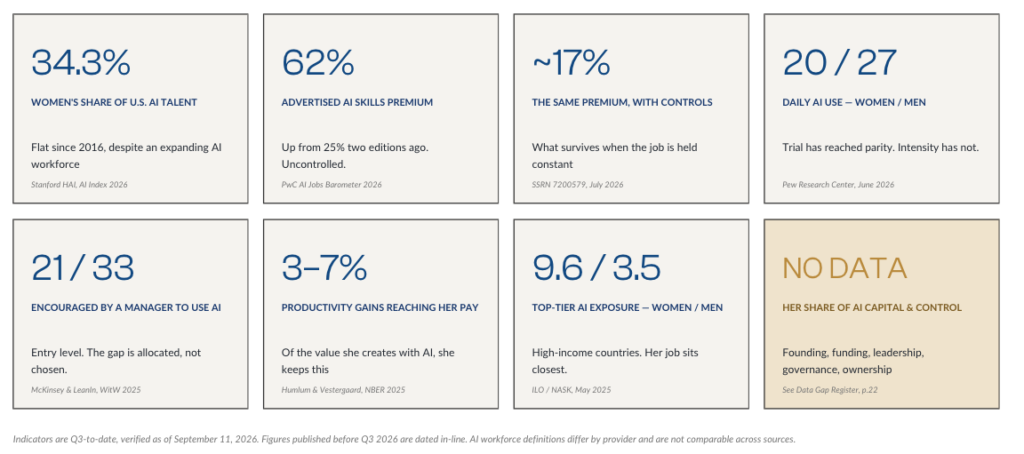
A few things stand out when you read these together.
Women reach for AI at the same rate. They’re handed it at two-thirds the rate. Consumer use has reached parity, but daily use and workplace encouragement haven’t. That points to a distribution gap, and distribution is a management decision. Where employers actively encourage use, the gap roughly halves. That makes it something a manager can fix this quarter.
Women’s jobs sit closest to the frontier. In high-income countries, women are roughly 2.7 times more concentrated in the occupations generative AI most directly reaches. Exposure doesn’t mean replacement, but it does mean women have to move first, often with the least institutional support.
The AI premium is real, and it’s mostly not reaching the worker. The best causal evidence we have finds that workers who use AI keep 3 to 7 cents of every dollar of productivity they create. The rest is increasingly booked as the firm’s organization capital. And under current U.S. law, what she builds with AI at work is either unownable or already owned by her employer.
We know precisely how exposed women are. We don’t know what they own. Five of the twelve indicators we set out to measure have no credible current data, and three more have no gender breakdown. Gender data is plentiful where women are users or at risk. It disappears at every layer where economic power is held: leadership, founding, funding, governance, and ownership.
Why This Matters Now
This quarter introduces two ideas we’ll keep building on.
The Value Capture Gap is the distance between the economic value a woman helps AI-enabled systems create and the value she personally captures, whether in pay, ownership, assets, decision rights, or options. It opens when AI raises her output but not her pay. It opens when she builds the workflow and the employer holds the IP, or when she operates the agents but doesn’t direct them.
We want to be careful here. The mechanism behind the gap is well documented, and it applies to every employee, regardless of gender. No study yet measures whether women capture less of AI’s value than men, because no one has looked. What we can say is that women are entering this structure on unequal terms: later, with less encouragement, from more exposed roles, and with no measurement of where they land.
The Operator Advantage is the response. It’s the leverage a woman creates when she combines her expertise, AI capability, owned assets, and relationships into a system that produces more than her direct labor alone, and structures it so she keeps a share of what it produces. That second part is the whole argument. Without it, the Operator Advantage is just productivity, and the data shows what productivity alone is worth to the person generating it.
The report breaks this into six capabilities that move a woman along the Portfolio Curve: see the value, deploy it, orchestrate it, own it, diversify it, and compound it. It also makes a point we think matters a lot: ownership runs through every stage of the Curve instead of waiting at the end of it. A woman early in her career can hold an asset. A fully fluent operator can hold nothing if everything she builds is work made for hire. So the practical question becomes simple: does this next move leave me holding anything?
The report closes with guidance by where she stands, from the student and early-career woman to the manager, the executive, and the consultant or entrepreneur. For managers in particular, there’s an easy lever. Encouraging women to use AI roughly halves the adoption gap, and it costs nothing.
None of this replaces the institutional work. Women should have equal pay, equal advancement, and real institutional power, and that work remains unfinished. But AI is making a second route viable at the same time, one built on skill, leverage, orchestration, and ownership. It makes a woman’s economic position less dependent on a single institution delivering everything before anything improves.
We’re not waiting 123 years
The goal is bigger than getting more women using AI. We want women to capture more of the economic value AI creates.
The World Economic Forum estimates 123 years to global gender parity at the current pace. We don’t plan to wait that long, and we don’t think the women reading this should either.
The full Q3 2026 Women in AI Quarterly Index walks through all three acts of the research, the complete Data Gap Register, the AI Value Chain, and practical guidance for wherever you stand today. If you’re building a portfolio career, leading a team through AI adoption, or shaping how your organization allocates AI work and decision rights, this is your briefing for the quarter.
Read the full Women in AI Quarterly Index Report – September 2026